Friday, November 4, 2016


Monday, September 1, 2014
Monday, July 23, 2012
As The Sun Descends
My Turkish friend drew on his pipe as he explained what the roads were like in the Shehar area near the mountain village of Taif. His words gave rise to anxious anticipation and captured my imagination of what layed ahead in the area south west of this ancient village. Tomorrow would be my first trek into an area that remained untouched by western man. For hundreds of years the outside world had left these back mountain recesses unexplored by outsiders. We have no preplanned itinerary. Our only plan was a long ramble on our dirt bikes, among the chain of mountains that lie south westward through the Shehar area. This was exactly how I liked it, it leaves little room for disappointment.
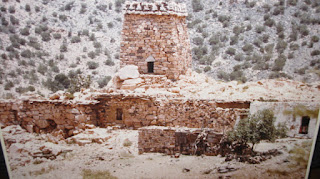 Early the next morning, our small group heads out of town, following a dirt road along the bank of a dry wadi (river) between two lines of craggy hills. The road has many rises and descents as it begins to twist up along side of the mountains. Each turn offers something different as we penetrate farther back. The odor of things green loads the breeze. Sawtooth mountains of red and brown rocks lacerate the sky. The primeval beauty of the region becomes more and more incredible the farther back we go. Sparsely spread among the valleys and jagged hills are ancient rock houses and towers, We stop near an old rock fort and tower to check out the view. We are on the apex of a mountain ridge beholding the view of the choice unspoiled valley below.
It was like we had stepped into a time machine that's carried us hundreds of years back as we watch sheppard's herding sheep along a mountain. The scene has erased the line between and past and present. Here in these tranquil mountains there is a quite so complete that time itself has ceased to roll on. It too stopped and waited . No city racket with flashing neon signs and restless competition that gets in at every opening jolting to pieces our very souls.
We had bagged one of the treasures of Arabia and rode home with our eyes to the sun as it descended into the mountains. Jack J. Johnstone
Friday, July 20, 2012
Reflections In The Bike Riders Eye
Feeling the encroachment of that catastrophe of boredom, anxious to escape what was an island solitude, we put on our boots mounted up riding straightaway into that parched infinity beyond. My riding partner was from Los Angeles, a veteran of dirt bike riding treks into Death Valley and the Mojave Deserts. He had rode with Steve McQueen, an avid dirt bike rider.
In those days the desert surrounding Al Khobar and Dhahran was still virgin territory, few foreigners had traversed this brutal terrain. The big dunes had not been fenced off and it was indeed a huge ocean of sand. The desert lured us into leaving the main roads. So there we were on a road that was no more a road, dissolved and broken off, leading into a land of unending harshness."Desert is a loose term to indicate land that supports no man", we are no more than a tenacious intruder irresistibly drawn by its challenging brutality, but man on a machine can only tame the desert here and there, and only momentarily, for within a day the wind will erase all tracks, of where we have been on its vast and overwhelming landscape.
We pass old windblown outposts and are suddenly catching a breeze off the Arabian Sea. We sit atop a dune deciding to leave some monument behind of our passing. We build a very diminutive pyramid of rocks atop the dune. A camel gives us a sidelong glance that tells us we are intruders on his ancient home. As we mount up to leave, a sudden blast of sandy, dusty wind reminds us that our monument too will have a short life expectancy out here.
Heading back and riding into the assault of a shamal beginning it's battery on us, we decide on a short cut through a large garbage dump. We run into acres and acres of trash with fires burning among rusty cans, bottles and bones. With the smoke rising there is a surreal picture and ghostly solitude as the wind pitches common things about the signs left by civilization. Those dead animals you see on the highway are brought here to burn. With the smell and morbid scene we race to get out of mans trash yard. I watch as a tattered coat does a strange dance on barbed wire in the wind. The fires that have burned here leave many things melted down, and they appear as wax in the suns rays. Amidst this sea of trash , I spy a doll have submerged in sand, with it's upraised arm it looks as if a wax tear is falling from its melted eye. "the tears of eternity, and sorrow, not mine but mans".

 As we pass the last dead camel, its mouth frozen open in an eternal scream, with the stench of him chasing us onto the highway. we are forever grateful to be gone. Now we are traveling with skeletons of bones beneath our skins and know what that hot roof leveling wind, bred on the desert is howling about.
Jack J. Johnstone (first published in The Northrop News 1975)
In those days the desert surrounding Al Khobar and Dhahran was still virgin territory, few foreigners had traversed this brutal terrain. The big dunes had not been fenced off and it was indeed a huge ocean of sand. The desert lured us into leaving the main roads. So there we were on a road that was no more a road, dissolved and broken off, leading into a land of unending harshness."Desert is a loose term to indicate land that supports no man", we are no more than a tenacious intruder irresistibly drawn by its challenging brutality, but man on a machine can only tame the desert here and there, and only momentarily, for within a day the wind will erase all tracks, of where we have been on its vast and overwhelming landscape.
We pass old windblown outposts and are suddenly catching a breeze off the Arabian Sea. We sit atop a dune deciding to leave some monument behind of our passing. We build a very diminutive pyramid of rocks atop the dune. A camel gives us a sidelong glance that tells us we are intruders on his ancient home. As we mount up to leave, a sudden blast of sandy, dusty wind reminds us that our monument too will have a short life expectancy out here.
Heading back and riding into the assault of a shamal beginning it's battery on us, we decide on a short cut through a large garbage dump. We run into acres and acres of trash with fires burning among rusty cans, bottles and bones. With the smoke rising there is a surreal picture and ghostly solitude as the wind pitches common things about the signs left by civilization. Those dead animals you see on the highway are brought here to burn. With the smell and morbid scene we race to get out of mans trash yard. I watch as a tattered coat does a strange dance on barbed wire in the wind. The fires that have burned here leave many things melted down, and they appear as wax in the suns rays. Amidst this sea of trash , I spy a doll have submerged in sand, with it's upraised arm it looks as if a wax tear is falling from its melted eye. "the tears of eternity, and sorrow, not mine but mans".


Jack J. Johnstone (first published in The Northrop News 1975)
Tuesday, May 29, 2012
Surviving in disguise


They flew over to Jeddah and sure enough the Stock Record Cards showed them being received back in the 1950's. They questioned the officers and men in the supply depot trying to locate these rather large pieces of equipment. These Half Tracks were as big as armored tanks with tracks, along with big diesel engines and armored plating on the sides.With the size of them, they would be hard to lose.
The army personnel explained that there were no people currently working there, that were there in the 1950's when they were received, and no knew of the whereabouts of these items. The two Americans continued questioning them, as they said everyone was dead, or retired that had worked in the supply depot at that time. The two US advisers said "surely someone knows of a retired army person that was here and still alive". One Saudi Officer said that there was an old retired soldier living in a small village, up in the mountains near Taif, and he had worked at the supply depot back then.
After getting directions to the village and acquiring an interpreter, with driver, they drove up into the mountains to the old mans village.He was a courtly old guy with white beard and hair. Through the interpreter this old man told them that he remembered the Half Tracks, and knew their location. He went on further to say, through the interpreter, that they would be required to drive him to the coast of the Red Sea, south of Jeddah. The next day with driver, interpreter and the old man, they found themselves driving along coast. Suddenly some distance, or miles south of Jeddah the old man told them to stop. He pointed east into the desert and told them to drive there, as usual the interpreter relayed this to the American advisers. They drove about three miles into the desert, the old soldier said "Stop here" in Arabic to the small group. He got out of the vehicle walked about 50 yards pointed down at the sand, and said there is one here, walked about another 50 yards pointing to the sand beneath him, and said the other ones here. After marking both locations, they drove back to Jeddah, looking forward to digging them up the next day, and wondering if the Half Tracks were really there..
The next day they returned with a flat bed truck, some shovels and a half dozen Yemenese laborers. They did the digging exactly where the old man had told the interpreter they were buried, and had been pointed out to them. Both of these vehicles were uncovered and in fantastic condition. The sand has a natural silicone in it. The tank like tracks were wrapped in paper and covered with cosmoline grease. en.wikipedia.org/wiki/M3_half-
They had brought new batteries and diesel fuel. As soon as they were uncovered, batteries changed, and fueled. The retired US Army Major started one up and drove it out of the hole, yelling like a cowboy, driving it in circles on the desert floor. He had driven one in WWII and this moment was both exciting and full of nostalgia for him.
The following day, they were having coffee while driving the old man back to his village, up in the mountains. They remarked on what a great memory he had and how much they admired him. All of a sudden he said with a British accent, " I was happy to help both you gentlemen". Stunned by his Oxford English, the two Americans looked at each other. The retired Major said to him " for three days you've been making us use an interpreter to speak with you, why did you do that? Your English is perfect!. The old man replied " It was quite entertaining listening to you discuss me and our little project". Having said that, the old guy raised his coffee cup to them and said "Cheers". Dumbfounded the two Americans fell silent, for a short while as they drove down the mountain road. Then the four of them, the interpreter, the old guy and the two Americans broke out in laughter.
Cheers, Jack Johnstone PS Shit Happens
Surviving In Disguise
During my seven years in Vietnam, I traveled many an open, but unsecured road. The highways of the Central Highlands, Highway 1 winding up the coast through rubber plantations and hamlets, and the highways around Saigon. Sometimes I only survived because I was small potatoes and the Viet Cong had a more important plan than shooting, or capturing me on the highway that particular day. However, they did on many occasions capture, or kill American military and civilians along the roads. Once my boss, an ex-Special Forces member, were on a road trip from Nha Trang to Da Lat. Bill Mc Cleary insisted on stopping to have a few beers, with a friend at an out-post along our route to Da Lat. He had me wringing my hands, as we sat and chatted with his friend. I knew we were pushing the envelope and would be caught in on the highway after dark. After dark no one was supposed to be traveling these roads. You were subject to be shot by both friendly forces and the Viet Cong.
As the sun went down, in the darkness, I was high tailing it down a mountain road towards a bridge, about twenty miles from Da Lat. All of a sudden automatic weapons fire opened up on both sides of the road. These were ARVAN's (Vietnamese Army) protecting the bridge. I slammed on the breaks, and our pick-up truck slid sideways down the road, screeching to a stop about a hundred yards from the bridge. A Vietnamese Officer approached our truck, with his weapon trained on us. He came to the drivers side and told me to get out of the truck. He told me that he wanted to show me something and to stay behind him. He pointed out a trip wire connected too a couple of Claymore mines on each side of the road. He had them disconnected and shook his head as I explained our predicament of traveling after dark. He flagged us on wishing us good luck, and I knew it was not over.
Not far out of Da Lat, we ran into a road block maned by National Guard. In their black pajamas they looked like VC to me, except they were carrying carbines and not AK-47's. Their leader approached our vehicle and looked in the window of our truck. He seemed not to look at my face, but starred at my wrist watch and pistol laying on the seat beside me. I'm sure he noticed that Bill McCleary held a Korean War vintage .45 cal. grease gun in his lap. It was known that the ARVN and National Guard had robbed and killed Americans on the highway at night. It may seem silly, but he looked just like the Chinese villain in the film Lord Jim, who tried to murder Peter O'Tool while taking him across the Hong Kong harbor at night. He wore a bandanna, and had glaucoma in one eye, giving him an extra sinister look. To this day I'm sure he wanted to rob us. The American musical group "The Bubble Machine" were shot and killed, not far out of Long Binh one night. One survived, but was wounded and played dead as the Vietnamese Army took their watches and wallets, after killing them.
My survival was not all dumb luck. One day near Nha Trang, I thought "what would make my trips safer on these unsecured roads". It dawned on me that if I looked like a Vietnamese, they would not just shoot me out of hand. On my next trip home, I went to a theatrical costume shop, on Powell street, just above Harpers Books. When the salesperson asked me what I was interested in, I asked if he could make me look like an Asian. He said he could and asked me if I was in a play. I replied that I was working in Vietnam, and wanted to use the disguise on road trips. Wow! he exclaimed, this is the most unusual request I've ever had. He presented me with a transparent mask, and wig to cover the borders of it. I carried it to Vietnam and kept it with me, wearing it on many occasions. From across the street, or in a passing vehicle, you could not tell that I had a mask on. I may be sitting here today because of this disguise, I have attached a picture of myself wearing it. People are funny about things like this story contains, if they have not seen, nor heard of anything like this in movies, or books, they become Doubting Thomas's. Years after I used this disguise, I heard that the CIA use this method for survival. I don't doubt it, simplicity of concept is powerful.

Subscribe to:
Posts (Atom)